Visual Processing: Carrion crows match primate decision logic at double speed
Researchers at the University of Tübingen found that birds without a neocortex use the same mathematical evidence accumulation as monkeys but reach visual judgments in half the time.
By Olga Kaur ·
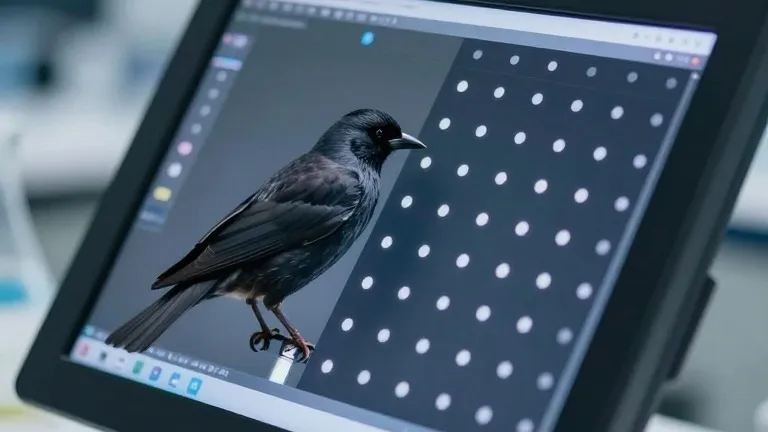
Two carrion crows completed a complex visual task in half the time required by monkeys, a new study reveals. The findings, published by researchers at the University of Tübingen, suggest that avian brains process ambiguous visual information with the same mathematical logic as primate brains, despite lacking the neocortex structure found in mammals.
The study utilized the random-dot-motion task, a standard tool in neuroscience where subjects observe a cloud of flickering specks drifting weakly in one direction. In primates, neurons in the neocortex collect this visual evidence until firing rates cross a specific threshold, triggering a decision. Because birds lack this distinct brain region, scientists had long questioned how they encode similar choices.
"This was the big question," said Andreas Nieder, a neurobiologist at the University of Tübingen. "How [would] a differently organized avian brain encode decisions?" To answer, Nieder and colleague Philipp Schmidbauer tested two hand-raised carrion crows while recording their brain activity.
The experimental setup mirrored the primate version exactly. The crows faced a touch-sensitive monitor displaying white dots on a black background. A subset of these dots drifted left, right, up, or down. The birds indicated their choice by pecking targets flanking the screen, with a mealworm serving as the reward for correct answers. The researchers noted that the only procedural difference from the monkey trials was the method of response, as crows pecked while monkeys used eye movements.
The team varied the difficulty by adjusting the percentage of coherent dots. At the easiest level, 81 percent of the dots moved together, making the direction trivially easy to identify. At the hardest level, only 3 percent moved coherently, a signal barely distinguishable from random noise. A third condition included zero coherent dots, presenting no correct answer.
The crows solved the task using the same evidence accumulation logic observed in primates. Their neural responses tracked the visual information over time in a manner consistent with the mathematical models derived from monkey data. However, the birds reached their final judgments significantly faster than their primate counterparts, demonstrating that a brain without a neocortex can execute comparable decision-making processes at twice the speed.
Source: Ars Technica