Arctic ice traps tankers in Russian strait
Sanctioned vessels stalled for up to two weeks in the Vilkitsky Strait, forcing a detour despite nuclear icebreaker support.
By Harper Hassan ·
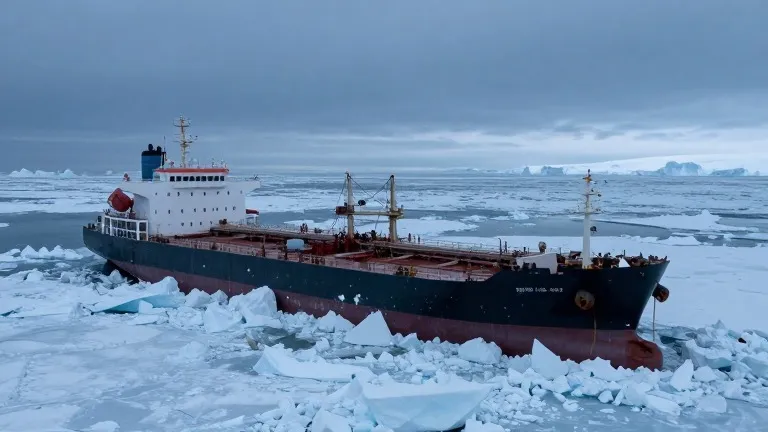
Russian tankers are stuck in ice.
In July, several sanctioned tankers became trapped in the Vilkitsky Strait. The strait is a 55 kilometer choke point on the Northern Sea Route between the Siberian coast and Bolshevik Island. The vessels were far above the Arctic Circle. Help from two nuclear powered icebreakers was days away.
Only one tanker made it through. The others waited as long as two weeks. The ice did not clear. The ships eventually took a different route. This delay challenges the Kremlin's view of the Arctic as a newly open passage. Ksenia Vakhrusheva, head of the Arctic project at Bellona, said less ice does not mean easier navigation. She explained that melting ice can pack tightly in narrow areas and block ships without ice class ratings.
President Vladimir Putin has called the route a reliable and safe path to major markets. Last month, he said 37 million tons of cargo moved along the route in 2025. He predicted that number would almost double by 2030. Officials in 2019 had targeted 80 million tons by 2024. Other data suggests a more modest story. The Center for High North Logistics reported that Russia shipped about 2 million tons of crude oil to Asia by the end of September. Reuters reported the total reached about 20 million barrels by mid October. That is a 50 percent rise over 2025 levels but only about 1 percent of Russia's seaborne oil exports.
Tomas Alexa, a senior analyst at Ambrey, called this a surge from a relatively low base. He said Western sanctions hamper Russia's ability to build and maintain Arctic capable vessels. Spare parts often route through third parties. Repair work once done by Norwegian, Danish, and Dutch firms is no longer available. Other countries are testing the route. South Korea reported its first container ship used the Northern Sea Route on October 22. Officials noted difficult conditions, including large ice floes. China also ran a scheduled container service to Europe for the first time this year.
Catherine Sendak of the Center for European Policy Analysis said Russia regards much of the Arctic as an inner waterway. Questions remain over tolls and services for commercial vessels. She wondered if Moscow might limit access for other actors. Security concerns are growing. EU foreign affairs chief Kaja Kallas said the region has become a front line of global power competition. NATO launched its Arctic Sentry mission in February. The United States announced plans last month to expand its military presence in Greenland.
Environmental groups warn of risks from more shipping. Vakhrusheva noted that oil degrades more slowly in cold conditions and can spread over ice. This could accelerate climate change effects. Russia publishes no information on incidents along the route. The area is so remote that no independent group can report on them.
Source: RFE/RL