Allied Fronts: How Moscow and Pyongyang Are Redefining the Asian Theater
New reporting suggests a deepening military exchange is driving a rapid shift in North Korea’s drone and missile capabilities, prompting an unexpected hypersonic response from Seoul.
By Olga Kaur ·
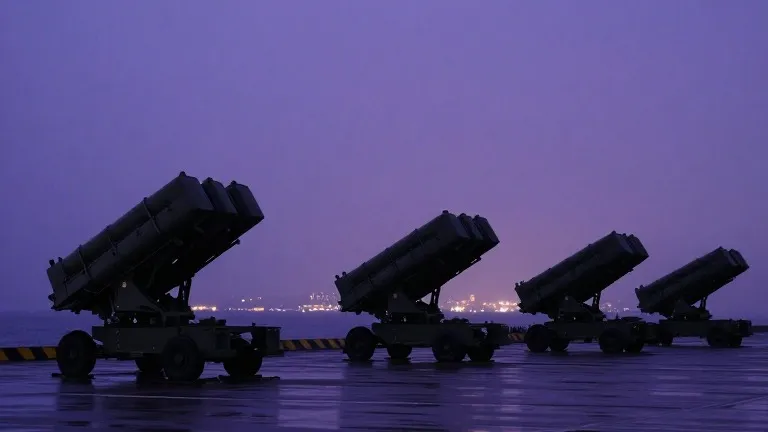
A new report from The New York Times reveals that North Korea has entered a phase of accelerated military modernization, significantly upgrading its ballistic missile systems and commencing mass production of attack drones. This surge in capability is attributed directly to an intensified partnership with Russia. The dynamic involves a reciprocal exchange where Moscow shares its latest military developments with Pyongyang, while North Korea contributes soldiers, workers, and various weapons to the Russian war effort. This collaboration has evolved from a post-invasion alliance into a structural dependency that is reshaping the strategic landscape in East Asia.
The tangible results of this cooperation became visible in early October when Pyongyang conducted a test of a tactical ballistic missile. The North Korean government claimed the weapon was capable of carrying a nuclear payload and boasted a range of 1,000 kilometers. However, analysts in South Korea and Japan estimated a more conservative flight distance of approximately 700 kilometers. These figures highlight the gap in intelligence assessments but also underscore the growing potency of the North’s arsenal, which is increasingly calibrated for precision and impact.
Seoul’s reaction to this latest launch marked a significant departure from its historical protocols. In the past, South Korea typically responded to such provocations with brief diplomatic statements. This time, the response was kinetic. Just five days after the North’s test, South Korea successfully launched its own hypersonic ballistic missile for the first time. President Lee Jae Myung personally observed the exercise, a move that signals a heightened level of concern within the administration regarding the pace of North Korean technological advancement.
Military analysts point to the transfer of Russian deployment data as a key factor in this progress. Anton Ponomarenko, an expert in the field, noted that access to this feedback loop has allowed Pyongyang to refine the accuracy and maneuverability of its weapons. This improvement has made the threat posed to South Korea more substantial, moving beyond simple deterrent power to a more immediate tactical danger. The integration of external data is proving to be a catalyst for rapid iteration in North Korean weapon design.
Beyond missiles, the partnership has focused on unmanned systems. Russia has assisted North Korea in building its own drone infrastructure and scaling up production. The rationale is drawn from recent conflicts in Ukraine and the Middle East, where inexpensive drones have demonstrated the ability to saturate and overwhelm expensive air defense networks. This lesson has been deeply embedded in North Korean strategic thinking, leading to a focus on volume and cost-effectiveness in their unmanned arsenal.
Recent drills have illustrated this new tactical doctrine. Last month, North Korea conducted an exercise in which a swarm of drones attacked a target island while cruise and ballistic missiles struck from multiple directions simultaneously. This coordinated approach tests the limits of defensive systems and suggests a future where air defenses must be redesigned to handle multi-vector, multi-layered attacks. Such changes would come at an exorbitant cost to South Korea and its allies, creating a significant financial and logistical burden.
This development follows a series of recent reports detailing the depth of the Russian-North Korean link. In September, Bloomberg revealed that up to 25,000 North Korean citizens are believed to be working in Russian military plants, particularly in the Alabuga special economic zone in Tatarstan. These workers are primarily engaged in the production of military drones, further cementing the labor and industrial exchange between the two nations.
The physical deployment of forces is also advancing. A North Korean missile unit, potentially equipped with 120 ballistic missiles and six launchers, has begun positioning itself in western Russia. These units are expected to support strikes against Ukraine, marking a direct operational involvement of North Korean assets in the European theater. This movement complements earlier requests, such as the August demand for KN-30 ballistic missiles, and follows a series of tests in June 2026 that included a modernized 240mm multiple-launch rocket system and a 155mm long-range artillery shell.
Source: Ukrainska Pravda