Kyiv Economic Strain: 140 Deaths and Supply Gaps
Shelter shortages have pushed four million residents into subway stations, while strikes on logistics hubs trigger supermarket shortages.
By Harper Hassan ·
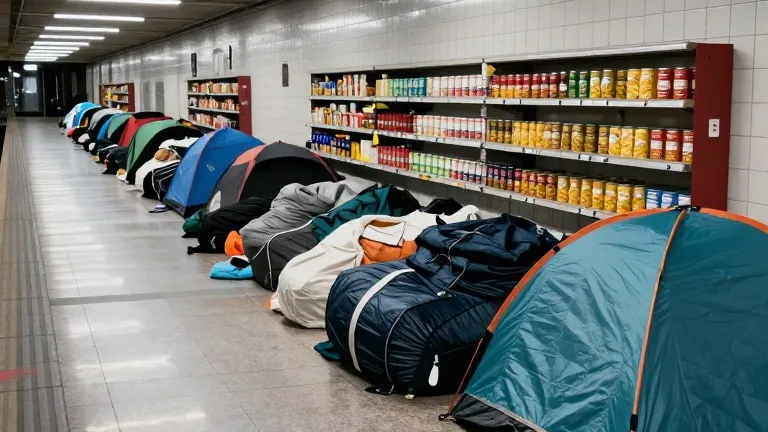
Supermarket shelves in Kyiv are running empty at levels not seen since the early months of the war. The shortage stems from repeated Russian strikes on warehouse infrastructure. These disruptions have created a supply bottleneck that is now affecting consumer goods across the capital.
Kyiv’s military administration reports that 140 people died in the city during the first eight months of 2026. This figure compares to a total of 172 deaths for the entire year of 2025. If the current rate of fatalities continues, 2026 will become the deadliest year for the capital since the full-scale invasion began in 2022.
The physical toll of the conflict has reshaped the labor and housing market. With insufficient shelter capacity for the city's four million residents, subway stations have become primary sleeping quarters. From approximately 10 p.m. nightly, residents lay out mattresses and set up tents. Workers commute from these underground spaces to offices, creating a new norm for urban labor logistics.
Energy costs and reliability have also fluctuated. Emergency power outages returned in late September. A Russian attack subsequently paralyzed the subway system, the city's main transit artery. Officials are currently assessing how the city will maintain heat, electricity, and water services through the winter as energy infrastructure remains a primary target.
Local businesses face operational uncertainty due to alert protocols. During "red" alerts, which indicate ballistic or cruise missile threats, employees must take immediate shelter. This often interrupts work shifts. During "yellow" alerts, some facilities continue operations. The curfew has been adjusted to run from 1 a.m. to 5 a.m., a change intended to preserve commercial activity during peak hours.
Education sectors are adapting their business models to fit shelter constraints. Schools continue in-person instruction because their facilities contain large shelters. One principal noted that her school can hold over 500 students. However, lessons are frequently cancelled if morning sirens trigger while students are still at home. Parents often miss work to manage childcare during these extended alerts.
Consumer confidence remains steady despite these operational challenges. A survey by the Kyiv International Institute of Sociology found that 72% of residents said in September they were prepared to endure the conflict for as long as necessary. The data suggests a high tolerance for disruption among the working population.
Source: Deutsche Welle
More Business · World news · Buyer Beware · Report a business · Got a Story?