West Bank Evictions Follow Checkpoint Attack
Local authorities report thousands displaced in Hebron following a military operation linked to recent violence and upcoming elections.
By Harper Hassan ·
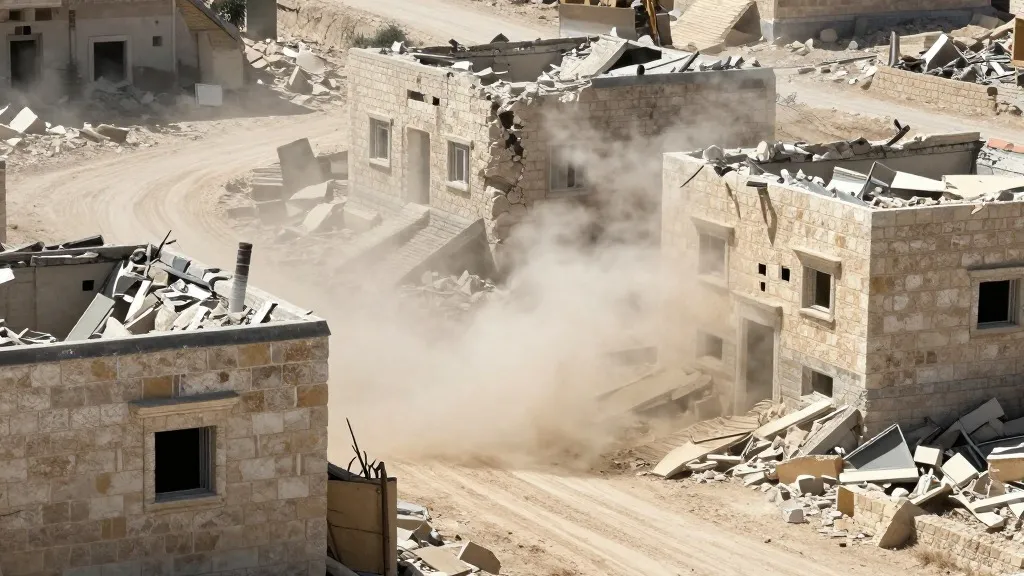
For residents of Hebron in the West Bank, the daily reality shifted dramatically this week as Israeli troops flattened a neighborhood and forced hundreds of families to leave their homes. Local Palestinian authorities describe the operation as a form of collective punishment in response to a militant attack on a military checkpoint. By Saturday afternoon, the Hebron municipality estimated that approximately 1,500 people had been displaced from the Ein Deir Baha district.
The scale of the destruction has been significant. The municipality stated that 35 hectares, or about 86 acres, within the district were either destroyed or marked for demolition. The city, which has a population of 250,000, was sealed off with checkpoints established at every point of entry. Video footage shared by a local resident showed extensive damage, with houses across several urban blocks reduced to rubble. In one clip, soldiers were seen spraying black crosses on buildings, while another showed a bulldozer dismantling a stone wall. A large residential building, reportedly belonging to a prominent local family, was draped in Israeli flags and taken over as a temporary military headquarters.
The military action followed an incident on Friday when two gunmen attacked an Israeli military checkpoint outside Hebron. A gunfight lasted about 20 minutes, resulting in the deaths of two Israeli soldiers and three wounded. Both gunmen were also killed. Local authorities alleged that the attackers hailed from the Ein Deir Baha district, which became the primary target of the subsequent operations.
With national elections scheduled for four days, political leaders have emphasized their response to the violence. Prime Minister Benjamin Netanyahu and Finance Minister Bezalel Smotrich visited the site of the initial attack. Netanyahu stated that Israel would act to destroy the area. Smotrich, who is running for election with a smaller coalition party, was filmed in body armor while standing in front of a demolishing building. He said he ordered the immediate demolition of a wide row of structures he described as illegal Arab buildings adjacent to the attack site. He also called for a comprehensive military campaign similar to those seen in Gaza and Lebanon.
Community leaders and local officials are providing shelter for those displaced. A municipality spokesperson indicated that about 300 families have been evicted so far. Some have moved in with friends and relatives, while others are staying in community halls and children's play areas set up by the municipality. The Palestinian news agency Wafa reported that Israel plans to displace an additional 2,500 people in the coming days.
Issa Amro, a civil rights activist in Hebron, criticized the scope of the operation. He noted that his own sister's family was among those forced from their homes. Amro described the situation as collective punishment for an event that most residents neither committed nor supported. He suggested that the suffering of innocent families is being used as political material for the upcoming elections.
In a telephone interview, Amro emphasized that many of the families leaving have no connection to Friday's attack. He expressed uncertainty about the long term strategy behind the operations, questioning whether the actions were primarily for election propaganda or part of a broader plan for the post election period. The Israeli army was approached for comment regarding the operations and the videos showing widespread destruction.
The situation in Hebron highlights the intersection of security responses and political timelines. As the military continues its operations, local residents face the immediate challenge of finding temporary housing while navigating the sealed off city. The coming days will likely see further developments as the election date approaches and the military clarifies its objectives in the district.
Source: The Guardian