Chip production costs: Why EUV limits raise the price of each Chinese wafer
Export controls bar ASML's extreme ultraviolet machines from China, forcing SMIC and CXMT to print some layers repeatedly on older tools.
By Fatima Davis ·
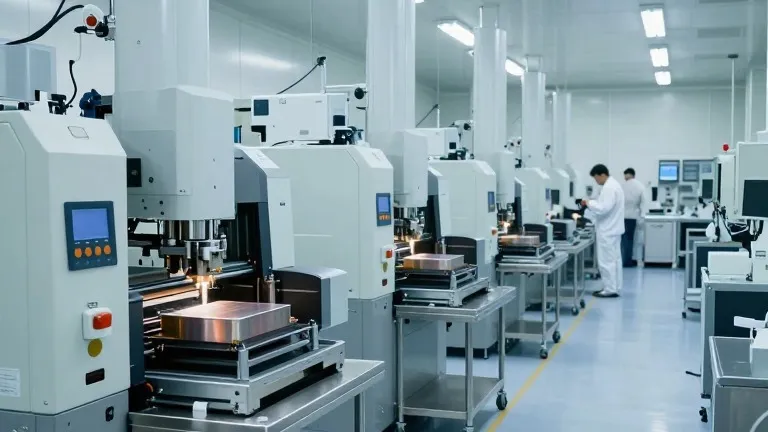
Export controls have kept ASML's extreme ultraviolet lithography machines out of China, leaving its chipmakers to work with older deep ultraviolet equipment that can print some designs only by running a layer through multiple passes. That workaround is now a measurable cost for SMIC and CXMT.
The technique, called multiple patterning, breaks an intricate layer into several simpler patterns built up step by step. Chris Mack, co-founder and CTO of semiconductor firm Fractilia, said the industry had held that three exposures on a 193 immersion tool cost about the same as one EUV exposure, but at four masks EUV became the cheaper option. Each additional pattern also has to align with what came before it, accumulating overlay errors that force designers to leave space around features. That enlarges the chip and cuts the number of dies per wafer, a costly trade when wafers run to tens of thousands of dollars. "You don't sell wafers, you sell die," Mack said.
China has still pushed further than analysts expected on DUV tools. A 2023 teardown of Huawei's Mate 60 Pro found its Kirin 9000S processor was built by SMIC on a second-generation 7nm-class process without EUV, and later analysis of the Kirin 9030 pointed to a DUV-based process approaching 5nm density, though it trails the leading nodes from TSMC and Samsung. Memory shows the gap in another form: a June report from Morgan Stanley estimated that CXMT produces about one-third as many bits per wafer as Western rivals and called lithography access a "hard ceiling" for Chinese memory development.
The route forward runs through both process limits and added equipment. Mack said he would be "hard pressed" to call a 3nm or 2nm node economically viable without EUV, but he noted Micron built its 1-alpha DRAM without the technology by combining multiple patterning with tight process control, an effort he said "pushed 193 farther than any of the other memory makers did." Morgan Stanley considers CXMT's planned move to 1-alpha DRAM for HBM3e achievable without EUV.
Cost alone does not stop capacity growth. Morgan Stanley assumes CXMT stays on 1-alpha without EUV and still raises its share of global DRAM bit supply from 14% in 2026 to 16% in 2028 through new greenfield capacity. The bank also projects China's AI chip self-sufficiency at 70% by 2030, up from 42% in 2025, while EUV, HBM and advanced software leave a gap that persists.
Source: Tom's Hardware