Cornell researcher studies how treeshrews coordinate eye and body movement
New findings suggest these small mammals use independent eye control to land on branches, challenging assumptions about non-primate vision.
By Fatima Davis ·
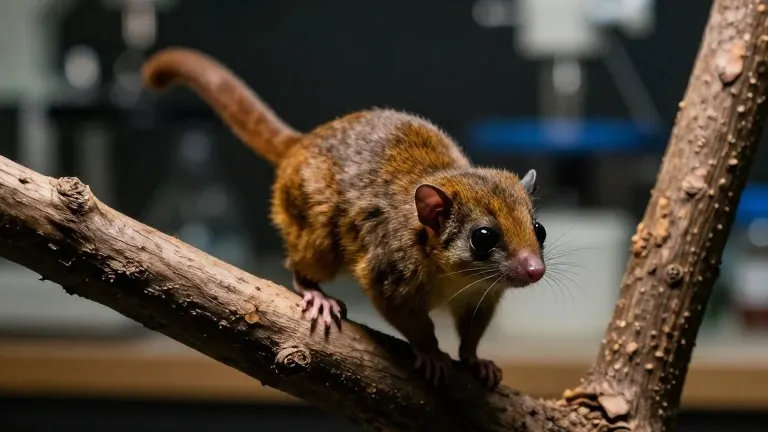
A recent study from Cornell University reveals that treeshrews possess a visual capability previously thought to be unique to primates. The research shows these small mammals can move their eyes independently of their heads to track targets and navigate their environment. This finding provides new insights into how the brain links sensory input with physical movement to create perception.
Madineh Sedigh-Sarvestani, an Assistant Professor of Neurobiology & Behaviour at Cornell, presented these findings during a Bodian Seminar hosted by the Zanvyl Krieger Mind/Brain Institute on Oct. 19. Her lab investigates how bodies and brains translate raw sensation into meaningful perception. Sedigh-Sarvestani proposes that the brain builds a "sensory-motor dictionary" over time, learning the predictable relationships between body movements and resulting sensory changes.
Traditionally, researchers expected animals with eyes on the sides of their heads, such as mice and rats, to rely on head movements for gaze shifting. Sedigh-Sarvestani’s team observed head-fixed treeshrews and found that 90% of their small, five-degree eye movements occurred without any accompanying head motion. The data indicates that treeshrews have a specialized visual system designed for sampling the binocular field directly in front of them, a trait more commonly associated with primates that move their eyes independently.
The biological advantage of this independent eye movement becomes clear when observing the animals in motion. Footage from the lab shows treeshrews leaping between branches and executing near 180-degree rotations in midair. By keeping their eyes oriented toward a landing point while their bodies rotate in the opposite direction, the animals maintain critical visual information throughout the jump. This ability allows them to perform complex acrobatic maneuvers that would be difficult if their gaze were locked to their head orientation.
To test the role of motor information in perception, the researchers altered the relationship between eye movement and visual input. In one experiment, they reversed the link between the animals’ eye movements and the movement of a visual target. The treeshrews adapted to this inverted control system within a matter of weeks. The lab is currently conducting further experiments using treeshrew-sized goggles fitted with inverting prisms, which flip the animals' visual world upside down.
Initially, the animals struggled with the inverted visual environment and hesitated to perform their typical jumps. Over time, they adjusted their movements and regained the ability to navigate their enclosure and leap between branches. Sedigh-Sarvestani noted that these animals are highly mobile and require vision for their movements, making them suitable candidates for studying how the brain recalibrates sensory-motor relationships. The results suggest that perception is not a passive reception of retinal data but an active process driven by the body's interaction with the environment.
Source: The Johns Hopkins News-Letter