Moon Water Supply Could Not Sustain a Million Residents Beyond a Century
A Harvard-led analysis estimates the lunar surface holds about one billion tonnes of water, enough to support one million people for roughly 100 years.
By Harper Hassan ·
Plans for large lunar settlements face a hard physical constraint: the moon does not hold enough water to support a million residents indefinitely, according to a study published in Frontiers in Space Technologies. The paper was written by Martin Elvis of Harvard University's Smithsonian Astrophysical Observatory and Jonathan McDowell, an honorary professor at the Durham University Space Research Centre in England.
Elvis said he and McDowell began the work after reading public claims about the scale and speed of lunar settlement. In February, SpaceX CEO Elon Musk posted on social media that the company had shifted its focus from Mars to building a "self-growing city on the moon" achievable in under 10 years, compared with more than 20 for Mars. Blue Origin CEO Jeff Bezos has said that "millions of people" will be living in space by 2045.
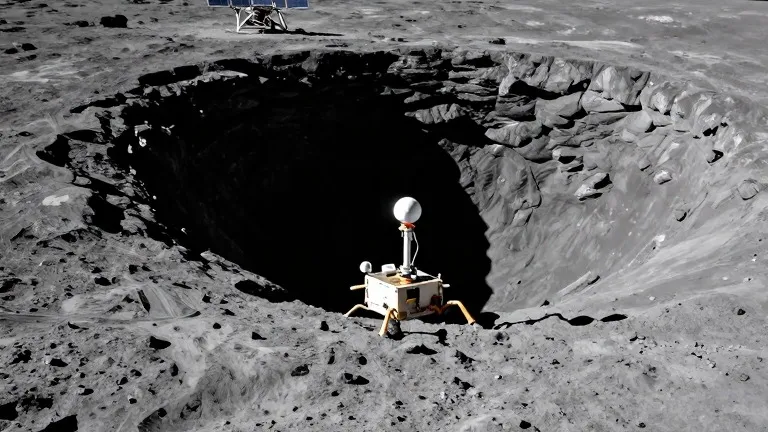
The researchers examined power and water separately. Solar and nuclear generation could supply enough energy for one million people on the lunar surface, they found. Water is the limiting factor. Most lunar water is believed to sit in permanently shadowed regions near the poles, where sunlight does not reach.
Using an estimate of roughly one billion tonnes of water, and assuming 98 per cent recycling at the rate achieved on the International Space Station, Elvis and McDowell calculated that a population of one million could persist for about 100 years. Elvis compared the volume to an aquarium the size of Central Park filled to just above the Statue of Liberty. "It's a small lake," he said, "and a small lake is not going to supply a big city for very long."
The same assumptions would let a settlement of 10,000 people last for centuries. McDowell said that scale is what the numbers support. "If you want to cover the face of the moon with cities, like in the best science fiction, then you have to find a way to get the water there, because it's not there right now," he said.
Elvis said the one billion tonne figure is probably "20 or 30 times too big," and that only one-third to one-half of the water present would likely be recoverable. His estimate of water that can be counted on is about one per cent of the original figure, which would reduce the 100-year figure to one year. Gordon Osinski, a professor of planetary geology at Western University in London, Ont., said satellite measurements carry uncertainties and that he wants confirmation on the ground. He said the water could resemble Arctic permafrost, with sub-millimetre ice crystals mixed into soil that are hard to extract.
The paper appears in Frontiers in Space Technologies. McDowell said the findings should not be read as discouraging. "The truth is never negative," he said. "What's negative is to actually go and try and do something that isn't going to work."
Source: CBC News